
Magnetic Track Lighting: How It Works, Cost, Advantages and Installation Guide
A practical guide for understanding 48V magnetic track lighting systems, pricing factors, installation options, smart control, and project planning.
Magnetic track lighting is a modular low-voltage lighting system that allows spotlights, linear lights, wallwashers, grille lights, and pendant modules to be installed on one track platform.
For residential, villa, showroom, hotel, office, and retail projects, the final cost depends on track length, installation type, lighting modules, power supply, smart control method, ceiling condition, and project quantity.
This guide explains how the system works, what affects magnetic track lighting cost, how different installation methods compare, and what information is needed for an accurate project quotation.
QUICK ANSWER
How Much Does Magnetic Track Lighting Cost?
The cost of a magnetic track lighting system is not calculated by track price alone. A complete system usually includes track profiles, lighting modules, power feeds, connectors, power supplies, control devices, accessories, installation method, and project quantity.
Surface-mounted systems are usually simpler and more cost-effective for retrofit projects, while trimless recessed systems require more ceiling preparation and installation work. Smart control options such as DALI, KNX, Casambi, or Zigbee can also affect the final system cost.
Track Length
Longer track layouts require more profiles, connectors, power feeds, and power planning.
Lighting Modules
Spotlights, linear lights, wallwashers, grille lights, and pendants have different prices and functions.
Installation Type
Surface-mounted installation is usually simpler, while trimless recessed installation requires more ceiling work.
HOW IT WORKS
How Does a 48V Magnetic Track Lighting System Work?
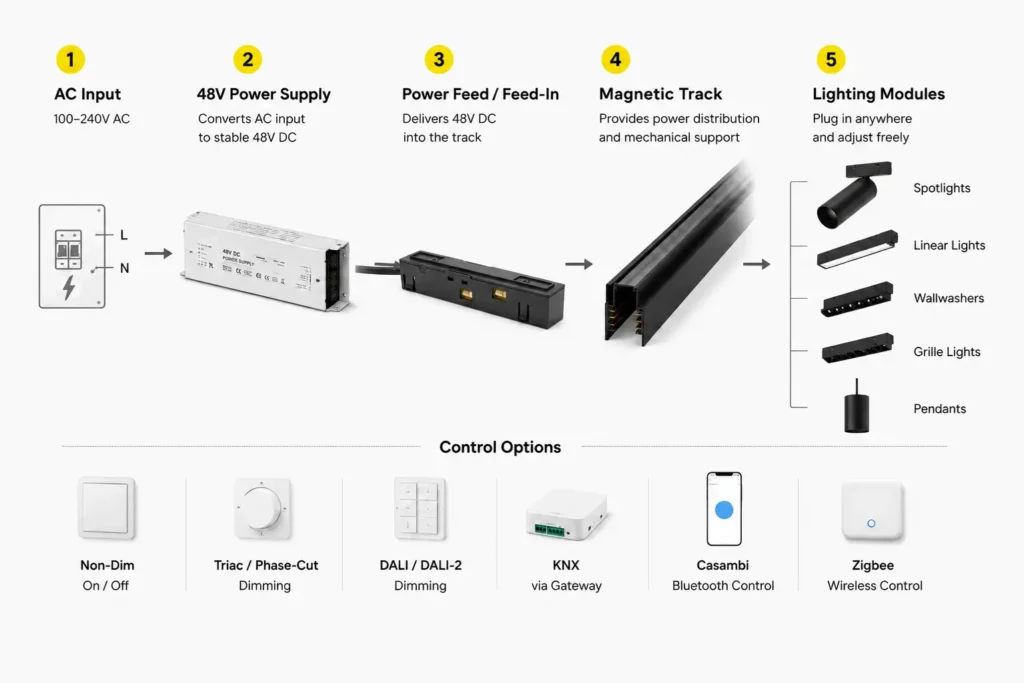
A 48V magnetic track lighting system uses a low-voltage track to provide power and mechanical support for different lighting modules. The magnetic adapter allows luminaires to be inserted, repositioned, or replaced more easily than traditional fixed lighting.
The system normally starts with an AC mains power supply, which converts power to 48V DC. The 48V output is delivered to the track through a power feed. Lighting modules are then installed into the track and powered through the internal conductors.
Depending on the project, the system can be configured as non-dimmable, DALI, KNX via gateway, Casambi, Zigbee, or other smart control solutions.
Power Supply
Converts mains voltage into stable 48V DC power for the magnetic track system.
Power Feed
Connects the 48V power supply to the track and delivers power into the circuit.
Magnetic Track
Provides the physical structure and electrical connection for lighting modules.
Lighting Modules
Spotlights, linear lights, wallwashers, grille lights, and pendants create different lighting layers.
COST FACTORS
What Affects the Cost of a Magnetic Track Lighting System?
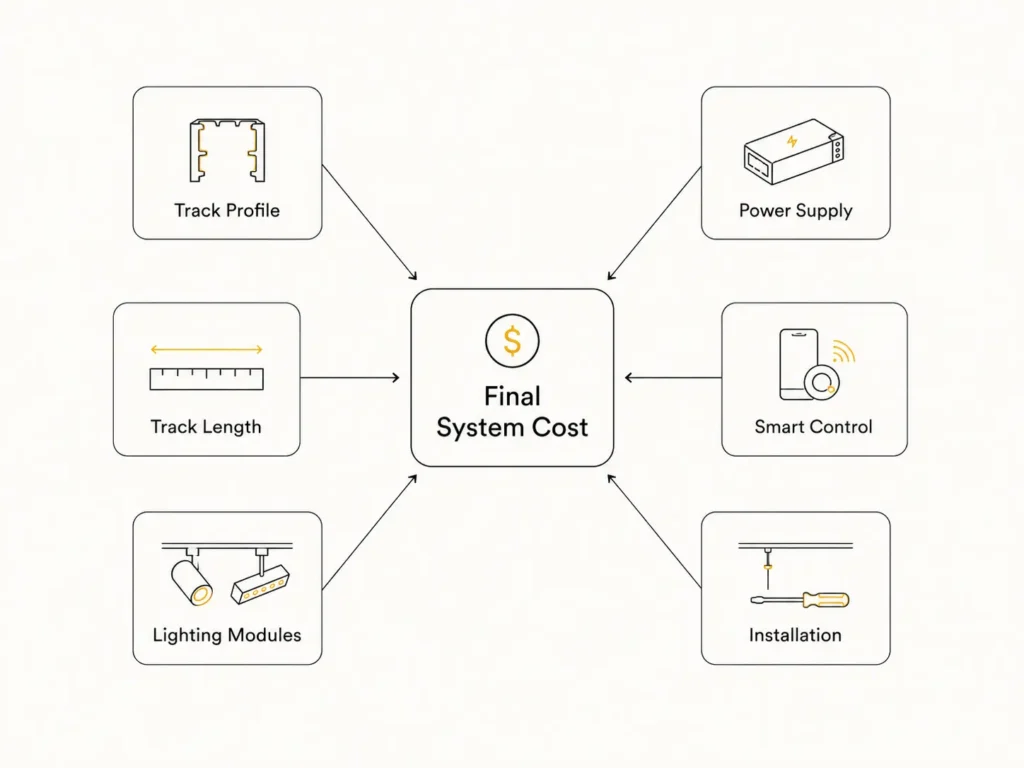
The final cost of magnetic track lighting depends on both product configuration and installation conditions. A simple surface-mounted layout with basic modules may cost less than a trimless recessed smart control system for a villa or commercial project.
Track Profile Type
Surface-mounted, suspended, trimless recessed, embedded trimless, and recessed-with-frame profiles have different material structures and installation requirements.
Track Length and Layout
Longer runs, L-shape layouts, T-shape layouts, curves, or multiple rooms require more track sections, connectors, power feeds, and planning.
Lighting Module Selection
Magnetic spotlights, grille lights, linear modules, wallwashers, and pendant modules have different prices depending on size, wattage, optics, finish, and control method.
Power Supply and Driver Solution
The number and capacity of power supplies depend on total wattage, track length, circuit design, driver type, and maintenance access.
Smart Control Method
Non-dim systems are simpler. DALI, KNX gateway integration, Casambi, Zigbee, or tunable white control may require additional drivers, controllers, gateways, or commissioning.
Installation Complexity
Surface-mounted installation is usually easier. Trimless recessed installation requires ceiling cutting, plasterboard work, finishing, and more coordination with contractors.
COST COMPARISON
Surface-Mounted vs Recessed Magnetic Track Lighting Cost
The installation method has a major impact on total project cost. Even when the lighting products are similar, ceiling work, wiring access, driver position, and finishing requirements can make the final installed cost very different.
| Installation Type | Product Cost | Installation Complexity | Best For | Cost Notes |
|---|---|---|---|---|
| Surface-Mounted Track | Lower to medium | Lower | Existing ceilings, concrete ceilings, retrofit projects | No deep ceiling cutting required |
| Suspended Track | Medium | Medium | High ceilings, showrooms, offices, open spaces | Requires suspension kits and alignment planning |
| Trimless Recessed Track | Medium to higher | Higher | Villas, apartments, premium residential interiors | Requires ceiling cutting, plasterboard work, and finishing |
| Embedded Trimless Track | Higher | Higher | Pre-planned architectural projects | Best when ceiling structure is prepared before installation |
| Recessed Track with Frame | Medium | Medium | Standard recessed ceiling installation | Easier than full trimless, but still requires ceiling opening |
If the ceiling is already finished or there is no false ceiling, surface-mounted or suspended magnetic track is usually the most practical and cost-controlled option.
INSTALLATION GUIDE
How Is Magnetic Track Lighting Installed?
Magnetic track lighting installation depends on the selected track profile and ceiling structure. Before installation, the ceiling material, wiring path, driver location, track length, power feed position, and control method should be confirmed.
For new projects, the track profile should be selected before ceiling construction. For renovation or existing ceiling projects, surface-mounted or suspended profiles are usually easier to install because they reduce the need for deep ceiling reconstruction.
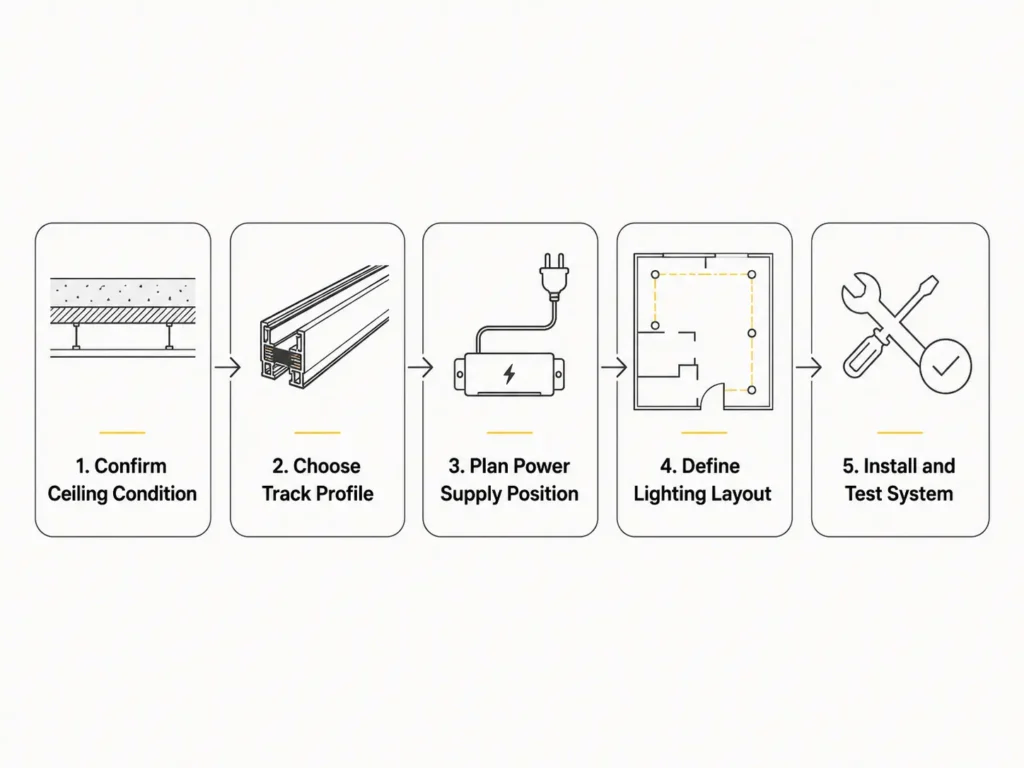
1. Confirm Ceiling Condition
Check whether the ceiling is concrete, plasterboard, finished, open, recessed, or still under construction.
2. Choose Track Profile
Select surface-mounted, suspended, trimless recessed, embedded trimless, or recessed-with-frame track according to the ceiling condition.
3. Plan Power Supply Position
Confirm where the 48V power supply, driver, power feed, and maintenance access will be located.
4. Define Lighting Layout
Plan track length, module type, beam angle, wattage, lighting zones, and control groups.
5. Install and Test System
Install the track, connect the power feed, insert lighting modules, test polarity, dimming, control functions, and lighting effect.
POWER PLANNING
Power Supply, Track Length and Voltage Drop
Power planning is important for magnetic track lighting, especially when the track layout is long or when many lighting modules are installed on the same circuit. Voltage drop can occur when the track is too long, the load is too high, or the power feed position is not planned correctly.
For stable performance, the total wattage, track length, power supply capacity, power feed position, and control method should be calculated together. For longer layouts, multiple power feeds or separated circuits may be recommended.
Total Wattage
Calculate the combined wattage of all lighting modules on each track circuit.
Power Supply Capacity
Select a 48V power supply with suitable capacity and safety margin.
Power Feed Position
Place power feeds properly to reduce voltage drop and improve system stability.
Circuit Separation
For long layouts or multi-room projects, separate circuits can improve performance and maintenance.
SMART CONTROL
How Smart Control Affects Magnetic Track Lighting Cost
Smart control can improve lighting comfort, scene control, and project value, but it also affects system configuration and cost. The cost difference depends on whether the project uses non-dim control, Triac dimming, DALI, KNX gateway integration, Casambi, Zigbee, tunable white, or other smart control methods.
For simple residential or retrofit projects, wireless control options such as Zigbee or Casambi can reduce control wiring complexity. For high-end villas, hotels, showrooms, and professional projects, DALI or DALI with KNX integration may provide more stable and scalable lighting control.
Non-Dim
Suitable for simple on/off lighting where dimming or scene control is not required.
Triac Dimming
Suitable for projects that need phase-cut wall dimming with compatible dimmable drivers or luminaire-integrated dimming solutions.
DALI / DALI-2
Suitable for professional dimming, grouping, and scene control in villas, hotels, offices, and showrooms.
KNX Integration
Suitable for whole-home automation when lighting needs to work with keypads, sensors, curtains, HVAC, and scenes.
Casambi
Suitable for wireless professional control, renovation projects, and flexible app-based commissioning.
Zigbee
Suitable for smart home app control, wireless scenes, and residential ecosystem integration.
PROS AND LIMITS
Advantages and Limitations of Magnetic Track Lighting
Magnetic track lighting is flexible, modern, and suitable for many architectural interiors, but it should still be planned correctly. Understanding both the advantages and limitations helps avoid wrong product selection and installation issues.
Advantages
Flexible Lighting Layout
Lighting modules can be repositioned, replaced, or combined according to changing room layouts.
Clean Ceiling Design
Slim track profiles and low-profile modules help create a modern architectural lighting effect.
Multiple Lighting Layers
Spotlights, linear lights, wallwashers, grille lights, and pendants can be used on one track system.
Smart Control Compatibility
The system can support DALI, KNX gateway integration, Casambi, Zigbee, and other control solutions.
Limitations
Compatibility Must Be Checked
Not all magnetic tracks and lighting modules from different suppliers are universally compatible.
Installation Needs Planning
Ceiling structure, driver position, power feed, and control method should be confirmed before installation.
Cost Can Vary
The final price depends on track length, modules, control method, installation type, and project quantity.
PROJECT QUOTATION
What Information Do You Need for an Accurate Magnetic Track Lighting Quotation?
To prepare an accurate quotation, Topsund needs to understand the project layout, ceiling condition, lighting requirement, installation method, and control system. The more complete the information, the more accurate the product recommendation and quotation will be.
If you do not have a complete lighting plan, you can send room dimensions, ceiling photos, and reference images. Topsund can help recommend a suitable magnetic track lighting configuration for your project.
FAQ
Frequently Asked Questions About Magnetic Track Lighting Cost and Installation
Need a Magnetic Track Lighting Cost Estimate for Your Project?
Send us your room layout, required track length, ceiling condition, lighting module preference, and control requirements. Topsund can help recommend a suitable 48V magnetic track lighting configuration and prepare a project quotation.